
Annuities

What is a fixed annuity?

An annuity is a long-term savings plan that can be used to accumulate assets on a tax-deferred basis for retirement and/or to convert retirement assets into a stream of income.

While both are insurance contracts, an annuity is the opposite of life insurance:

  • Life insurance provides financial protection against the risk of dying prematurely.
  • An annuity provides financial protection against the risk of living too long and being without income during retirement.

As with any investment, however, there are also potential disadvantages that should be evaluated before purchasing a fixed annuity.

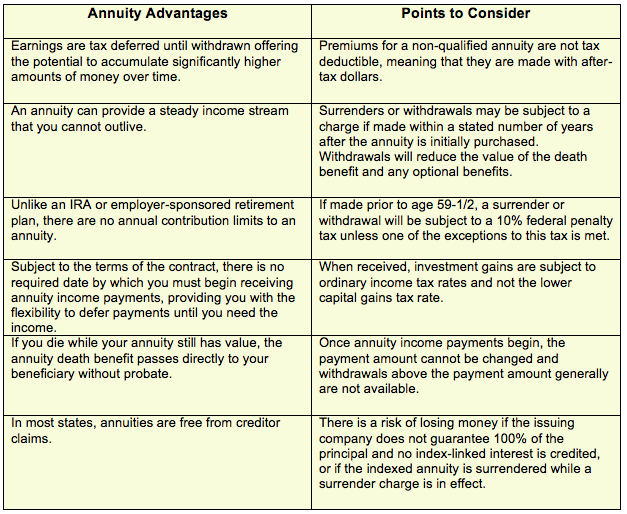
Advantages:

  • An annuity can be used to provide a steady source of retirement income that you cannot outlive.
  • Unlike an IRA or employer-sponsored retirement plan, there are no annual contribution limits to an annuity…you can contribute as much as you want.
  • Subject to the terms of the contract, there is no required date by which you must begin receiving annuity income payments, providing you with the flexibility to defer payments until you need the income.
  • If you die while your annuity still has value, the annuity death benefit passes directly to your beneficiary without probate.
  • In most states, an annuity is free from the claims of a creditor.

Disadvantages:


  • Premiums for a non-qualified annuity are not tax deductible, meaning that they are made with after-tax dollars.
  • While you can surrender or make withdrawals from an annuity before you begin receiving income payments, the surrender or withdrawal may be subject to a charge if made within a stated number of years after the annuity is initially purchased. Withdrawals will reduce the value of the death benefit and any optional benefits.
  • If made prior to age 59-1/2, a surrender or withdrawal will be subject to a 10% federal penalty tax unless one of the exceptions to this tax is met.
  • When received, investment gains are subject to ordinary income tax rates and not the lower capital gains tax rate.
  • Once annuity income payments begin, the payment amount cannot be changed and withdrawals above the payment amount generally are not available.

What is an indexed annuity?

An indexed annuity can be a great way to save for retirement on a tax-deferred basis, in effect creating your own personal “pension” plan. Fixed index annuities have the potential for market-linked interest without exposure to the market risk. Contract owners enjoy the guarantees and safety of principal even while being linked to market growth. Since a fixed index annuity uses a passive investment strategy, it will not mirror the exact return of the stock market index. The fixed index annuity is a powerful financial tool designed to meet your long-term retirement needs.

As with any investment, however, there are also potential disadvantages that should be evaluated before purchasing an indexed annuity.

Advantages:


  • An indexed annuity provides the opportunity to benefit from a rising stock market with an interest rate linked to a market index, while also offering a minimum guaranteed interest rate.
  • Indexed annuity earnings are tax deferred so long as they remain in the annuity. When compared to an investment whose earnings are taxed each year, tax deferral offers the potential for accumulating significantly higher amounts of money over time.
  • An annuity can be used to provide a steady source of retirement income that you cannot outlive.
  • Unlike an IRA or employer-sponsored retirement plan, there are no annual contribution limits to an annuity…you can contribute as much as you want.
  • Subject to the terms of the contract, there is no required date by which you must begin receiving annuity income payments, providing you with the flexibility to defer payments until you need the income.
  • If you die while your annuity still has value, the annuity death benefit passes directly to your beneficiary without probate.
  • In most states, an annuity is free from the claims of a creditor.

Disadvantages:


  • Premiums for a non-qualified annuity are not tax deductible, meaning that they are made with after-tax dollars.
  • While you can surrender or make withdrawals from an annuity before you begin receiving income payments, the surrender or withdrawal may be subject to a charge if made within a stated number of years after the annuity is initially purchased. Withdrawals will reduce the value of the death benefit and any optional benefits.
  • There is a risk of losing money if the issuing company does not guarantee 100% of the principle and no index-linked interest is credited, or if the indexed annuity is surrendered while a surrender charge is in effect.
  • If made prior to age 59-1/2, a surrender or withdrawal will be subject to a 10% federal penalty tax unless one of the exceptions to this tax is met.
  • When received, investment gains are subject to ordinary income tax rates and not the lower capital gains tax rate.
  • Once annuity income payments begin, the payment amount cannot be changed and withdrawals above the payment amount generally are not available.

Second Opinion

You should get a second opinion just like you would from a doctor……

At Pendo Insurance Services, we believe that second opinions are wise. We will give a FREE review and expert second opinion and if you already have a contract, we can call your current company together and have them tell you, we have a better contract then what you are currently in.